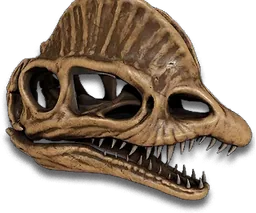
Dilophosaurus Skull
- Hall
- Main hall
- Crafting
- Not craftable
- Upgrade resource
- Oil
- Max benefit level
- 10
All tables CSV · JSON · Data downloads
On this page
- Hall
- Main hall
- Crafting
- Not craftable
- Upgrade resource
 Oil
- How to obtain
- Marco Polo · events
- Announced price (2024–2025)
 100–300
- Modifiers and levels
- 5 modifiersLevels 1–10
Archaeology Capstone does not apply to this artifact. Its base values are shown.
Archaeology CapstoneBenefits (community data)
±
| Slot | Benefit | Lv 1 | Lv 2 | Lv 3 | Lv 4 | Lv 5 | Lv 6 | Lv 7 | Lv 8 | Lv 9 | Lv 10 |
|---|---|---|---|---|---|---|---|---|---|---|---|
| 1 | Oil from Oil Wells | +16% | +17% | +18% | +19% | +20% | +21% | +22% | +23% | +24% | +25% |
| 2 | First Aid Duration | +16% | +17% | +18% | +19% | +20% | +21% | +22% | +23% | +24% | +25% |
| 3 | Generals' Hitpoints | +7% | +8% | +9% | +10% | +11% | +12% | +13% | +14% | +15% | +16% |
| 4 | Supply Vehicle Healing | +11% | +12% | +13% | +14% | +15% | +16% | +17% | +18% | +19% | +20% |
| 5 | Barracks Troop Hitpoints | +7% | +8% | +9% | +10% | +11% | +12% | +13% | +14% | +15% | +16% |
Level-up cost
| Level | Cost |
|---|---|
| 2 | 2,000 40 |
| 3 | 10,000400 |
| 4 | 20,000600 |
| 5 | 30,000800 |
| 6 | 40,0001,000 |
| 7 | 50,0001,400 |
| 8 | 60,0001,800 |
| 9 | 80,0002,000 |
| 10 | 120K2,400 |
Possible benefits for this category →
Sources and notes
How to obtain
132 Legendary artifacts cannot be crafted: they come from limited-time events, sales and Marco Polo, paid for with Legendary Tokens that drop from Mystery Chests and events.
Price
132 Legendary artifacts are sold in limited-time events and by Marco Polo for Legendary Tokens. Official announcements from 2024 to 2025 put them at 100 to 300 tokens each; the event running at the time sets the price, so it changes between events.
Modifiers and levels
Every Legendary artifact has 5 modifiers.
Each modifier levels on its own from 1 to 10. It grows by a fixed step per level, so a modifier that starts at 12% reaches 21% at level 10. Levelling changes only the strength, never which modifiers an artifact has.
Description
In the Early Jurassic period, nearly 184 million years ago, North America consisted of desert with rivers flowing through it, and was the native environment of the Dilophosaurus. With a light build and speed used to quickly catch it’s prey, this carnivore was considered to be an active hunter of it’s time, eating smaller dinosaurs, reptiles, and fish. A portion of the Dilophosaurus skeleton was first discovered in Tuba City, Arizona by a Navajo man named Jesse Williams, then sent to the University of California, Berkeley to be studied by the paleontologist Samuel Welles. He named the creature the Dilophosaurus, from the Greek word ‘lophos’ meaning crested, and the prefix ‘di’ meaning two due to the double crests on it’s head that are easily visible from it’s scull. Modern media tends to portray the Dilophosaurus as a creature that is small and spits venom, but in reality, they were a similar size to a modern day adult brown bear, and most paleontologists agree that it was very unlikely that this creature secreted venom in any form. Though many speculate on the other physical attributes of this creature, it is currently impossible to confirm if it had hair or feathers, but the continued study of these ancient beasts may provide an answer to that question someday.
Data notes · 13.1600 · 13.1610
Related
Used by
Affects 210
Oil from Oil Wells 1
First Aid Duration 1
Generals' Hitpoints 30
Supply Vehicle Healing 3
Barracks Troop Hitpoints 175
Names in other languages
- 简体中文
- 双冠龙头骨
- 繁體中文
- 雙冠龍頭骨
- 日本語
- ディロフォサウルスの頭蓋骨
- 한국어
- 딜로포사우루스 두개골
- Deutsch
- Dilophosaurus-Schädel
- Español
- Cráneo de Dilophosaurus
- Français
- Crâne de Dilophosaurus
- Italiano
- Teschio di dilophosaurus
- Português
- Crânio de dilofossauro
- Русский
- Череп дилофозавра
- Türkçe
- Dilophosaurus Kafatası
Report an error or add information

In the Early Jurassic period, nearly 184 million years ago, North America consisted of desert with rivers flowing through it, and was the native environment of the Dilophosaurus. With a light build a…
- Hall
- Main hall
- Crafting
- Not craftable
- Upgrade resource
- Oil