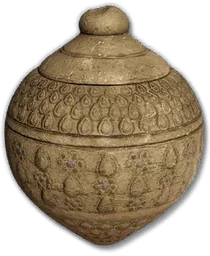
Greek Fire Pot
- Hall
- World War hall
- Crafting
- Not craftable
- Upgrade resource
- Oil
- Max benefit level
- 10
All tables CSV · JSON · Data downloads
- Hall
- World War hall
- Crafting
- Not craftable
- Upgrade resource
 Oil
- How to obtain
- Marco Polo · events
- Announced price (2024–2025)
 100–300
- Modifiers and levels
- 5 modifiersLevels 1–10
Library research; applies only to World War Hall Legendary artifacts. It does not apply to Mythical artifacts. Base values are shown until you enable it.
Archaeology CapstoneLevel-up cost
| Level | Cost |
|---|---|
| 2 | 2,000 40 |
| 3 | 10,000400 |
| 4 | 20,000600 |
| 5 | 30,000800 |
| 6 | 40,0001,000 |
| 7 | 50,0001,400 |
| 8 | 60,0001,800 |
| 9 | 80,0002,000 |
| 10 | 120K2,400 |
Possible benefits for this category →
Sources and notes
How to obtain
132 Legendary artifacts cannot be crafted: they come from limited-time events, sales and Marco Polo, paid for with Legendary Tokens that drop from Mystery Chests and events.
Price
132 Legendary artifacts are sold in limited-time events and by Marco Polo for Legendary Tokens. Official announcements from 2024 to 2025 put them at 100 to 300 tokens each; the event running at the time sets the price, so it changes between events.
Modifiers and levels
Every Legendary artifact has 5 modifiers.
Each modifier levels on its own from 1 to 10. It grows by a fixed step per level, so a modifier that starts at 12% reaches 21% at level 10. Levelling changes only the strength, never which modifiers an artifact has.
Description
The chemical compound known as Greek fire is a liquid capable of burning on the surface of the ocean, making it particularly deadly in naval combat. Sailors were unable to escape into the water if their ship caught fire, as the flames could spread there too - with the help of this liquid. Even to this day, scientists are perplexed by Greek fire’s contents, but speculate that it was some combination of petroleum, sulfur, and quicklime, in conjunction with other unknown ingredients.
The vessels that held this compound varied; when used on land and launched by an individual soldier, an earthenware clay pot was most effective due to the small, portable size and break-ability on contact with its target. On the ocean, in contrast, naval combatants would need an efficient way of launching a large quantity of Greek fire at their opponents, so a large tube was mounted to the front of a ship, able to spray the liquid forward and to either side of the vessel.
Artifact effect values missing · 13.1610
Related
Used by
Names in other languages
- 简体中文
- 希腊火
- 繁體中文
- 希臘火
- 日本語
- ギリシア火の陶器
- 한국어
- 그리스의 불 항아리
- Deutsch
- Topf mit Griechischem Feuer
- Español
- Vasija de fuego griego
- Français
- Pot à feu grégeois
- Italiano
- Recipiente di fuoco greco
- Português
- Pote de Fogo Grego
- Русский
- Горшок с греческим огнем
- Türkçe
- Rum Ateşi Çömleği
Report an error or add information

The chemical compound known as Greek fire is a liquid capable of burning on the surface of the ocean, making it particularly deadly in naval combat. Sailors were unable to escape into the water if th…
- Hall
- World War hall
- Crafting
- Not craftable
- Upgrade resource
- Oil