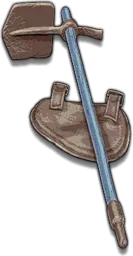
The Frontline's Entrenching Tool
- Hall
- World War hall
- Region
- Europe
- Crafting
- Craftable
- Upgrade resource
- Oil
All tables CSV · JSON · Data downloads
- Hall
- World War hall
- Region
- Europe
- Crafting
- Craftable
- Upgrade resource
 Oil
- How to obtain
- Museum crafting
- Modifiers and levels
- Varies by qualityLevels 1–10
Level-up cost
| Level | Cost |
|---|---|
| 2 | 2,000 40 |
| 3 | 10,000400 |
| 4 | 20,000600 |
| 5 | 30,000800 |
| 6 | 40,0001,000 |
| 7 | 50,0001,400 |
| 8 | 60,0001,800 |
| 9 | 80,0002,000 |
| 10 | 120K2,400 |
Sources and notes
How to obtain
162 Weapon, Armor, Jewelry, Pottery and Equipment artifacts are crafted in the Museum with Mysterious Fragments.
Modifiers and levels
How many modifiers a crafted artifact has depends on its quality: crafting rolls the starting quality, and unlocking a higher quality adds benefits.
Crafting gives the first quality level 90% of the time and the second 10%; higher levels only come from unlocking.
Each modifier levels on its own from 1 to 10. It grows by a fixed step per level, so a modifier that starts at 12% reaches 21% at level 10. Levelling changes only the strength, never which modifiers an artifact has.
Description
Life in the trenches was more than just combat. Soldiers had to eat, sleep, and live in these trenches for long periods of time. As such, many trenches had cooking areas, barbers, smaller dugouts for sleeping, and latrines. Most soldiers would only be on the frontline for a week or two at a time before being pulled back to support or reserve lines. Even so, there were rare cases of soldiers, particularly of nations that had little reinforcements to give, that would stay on the frontline for months at a time.
Trench warfare was a constant throughout World War I. There were many innovative ways to quickly build trenches, but still the simplest method was the most common - digging with shovels. Standard issue entrenching tools often came with sharpened edges so that they could be used as melee weapons when a bayonet would be too large and cumbersome. The safest way to dig a trench in combat was called sapping, which allowed soldiers to dig while still inside of their trench. The largest drawback to sapping was that only two men could dig at a time, since the space they had to work in was limited. Often times soldiers had to dig trenches out in the open with nothing but the cover of night to protect them.
Data notes · 13.1610
Names in other languages
- 简体中文
- 前线的壕沟挖掘工具
- 繁體中文
- 前線的壕溝挖掘工具
- 日本語
- 前線の塹壕掘削用シャベル
- 한국어
- 최전선 야전삽
- Deutsch
- Frontlinien-Schanzzeug
- Español
- La herramienta de atrincheramiento en el frente
- Français
- Outil de tranchée du front
- Italiano
- Pala da trincea di prima linea
- Português
- A ferramenta de entrincheiramento da linha de frente
- Русский
- Саперная лопатка с передовой
- Türkçe
- Cephe Siper Kazma Aleti
Report an error or add information

Life in the trenches was more than just combat. Soldiers had to eat, sleep, and live in these trenches for long periods of time. As such, many trenches had cooking areas, barbers, smaller dugouts for…
- Hall
- World War hall
- Region
- Europe
- Crafting
- Craftable